
Three things that look like something else.
The cost lands months after the misread.
1. Broken trust read as poor performance.
3. Your early call read as your character.
2. Silence read as agreement.
TeamRealityCheck™
Not a workshop. A way of working.
TeamRealityCheck™ (TRC) starts with an assessment - but that's just the beginning. The real value is the ongoing conversation it creates inside your team. It fits into your existing rhythm: your weekly call, stand-ups meetings or retrospectives, and your one-on-ones. No separate programme. No extra meetings. Just attention to relationships and honest questions asked consistently.
Why it works?

You stop guessing what your team needs from you.
You see where your assumptions about your role collide with theirs - before that conflicts costs you credibility.
You know which relationships can absorb pressure and which ones can't.
You lead with a map supporting your intuition.
For the Leader

You become visible and appreciated for your values and strengths.
Not assumed.
What motivates you, what drains you, and where your working style creates friction with others: it's named, not buried.
You stop being managed based on someone else's guesses about who you are.
For the team Member

Friction gets surfaced before it becomes a performance problem.
Alignment becomes explicit.
Accountability becomes possible because everyone agreed to the shared goal.
“ZERO-based” assumption principles reduced each person private assumptions.
You can finally hold each other accountable to something real.
For the Team

Who it’s for
Senior, high-expertise teams under real pressure
TRC™ is not for every team. It's designed for environments where the people are smart, experienced, and hard to replace — and where the challenge isn't competence but alignment. Think LifeScience, FinTech, Consulting, BioTech, HealthTech. Teams where strong opinions, deep expertise, and high stakes make invisible dynamics particularly expensive.
Leaders taking over TeamsStepping into a team you didn't build. You need to see where trust lives, who drives what, and which relationships you've inherited — fast.
Product & Strategy TeamsCross-functional teams under pressure - M&A integrations, product launches, transformation programmes where the stakes leave no room for trial and error.
Cross-boarder Global Complex ProjectsInternational deployments where two teams meet for the first time on-site. Technology transfers, clinical setups, regulatory harmonisation.
Late Stage scale ups and SMEThe founding team that worked in a garage doesn't operate the same at 30 people. Leadership change, scaling friction, co-founder misalignment.
Here is a full picture
Not every team needs every dimension. The combination is tailored to your context, your industry, and the transition you're navigating. But these are the areas where invisible dynamics most commonly live.
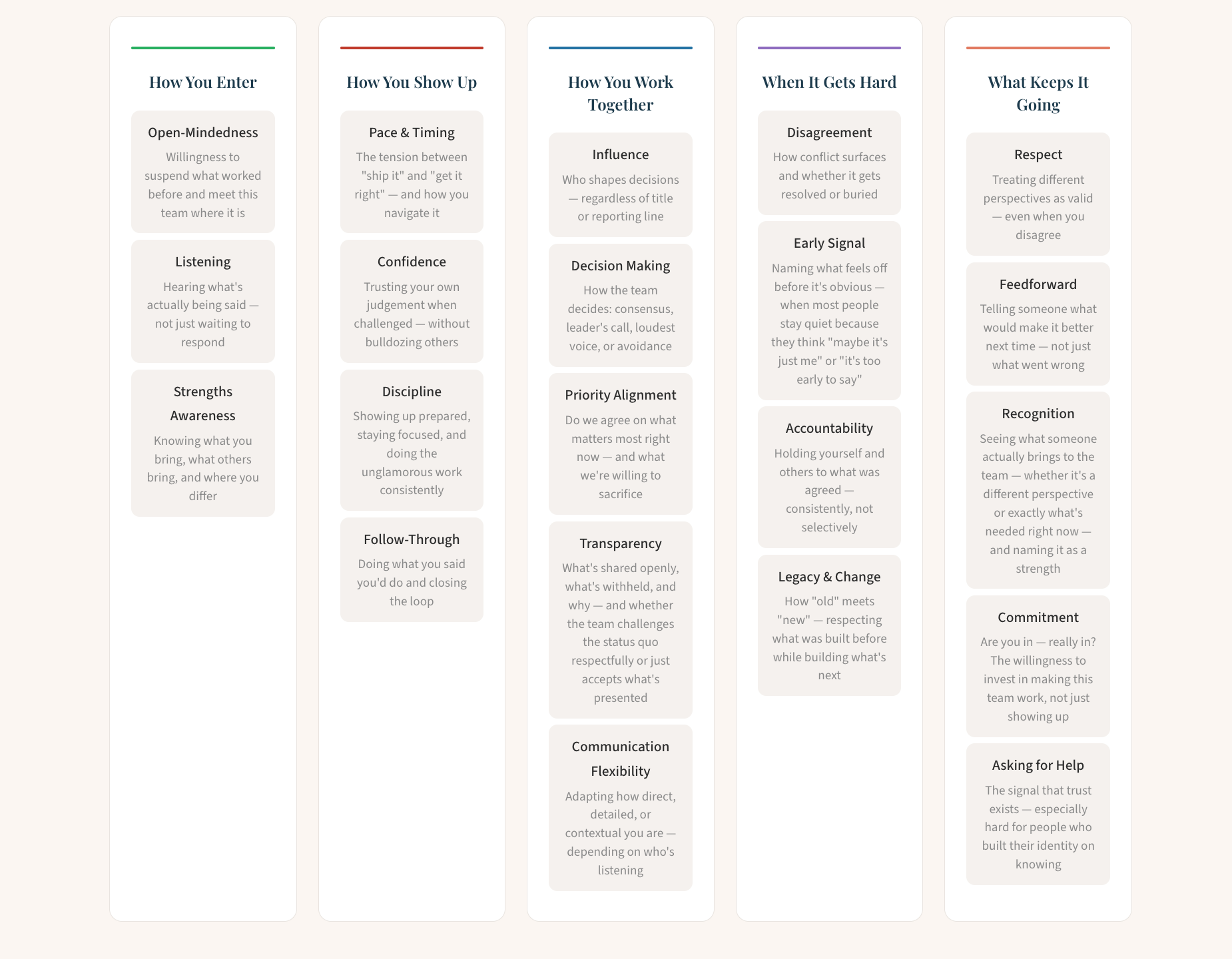
Where TeamRealityCheck creates the most value
Designed for high-stakes transitions where the real risk isn't technical — it's relational.
Application Scenarios
Leadership Transition
New leader inherited a team after M&A or layoff.
Cross Boarder Deployment
International team of experts working together for a high stake product deployment
Critical Transformation Project
Digital or AI transformation projects with high stakes and limited resources
Let’s begin the conversation
Whether you're leading a team through change or wondering why the old playbook stopped working, a short conversation can make the trust pattern visible.